
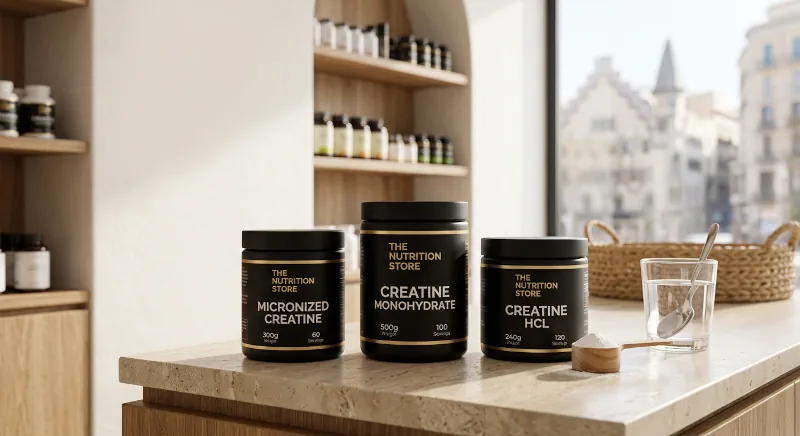
Looking for the best creatine in Barcelona? Creatine monohydrate remains the sensible choice for most people—but choosing the right type is only part of the equation.
Spend enough time in a Barcelona supplement shop and you hear the same questions. Which creatine should I buy? Is Creapure® better? Is 5 grams enough? Do I need a pre-workout too?
It’s understandable. Look at a supplement shelf and suddenly creatine seems complicated: monohydrate, HCl, citrate, nitrate, buffered creatine, Kre-Alkalyn® and more.
Yet when customers ask me which creatine I’d choose, I keep coming back to the boring one: creatine monohydrate. And when manufacturing quality and traceability are priorities, Creapure® creatine monohydrate. Here’s why.
Creatine, ATP and Why It Works
ATP (adenosine triphosphate) is essentially immediate energy your muscles can use. When ATP releases energy, it becomes ADP.
During short, intense efforts, phosphocreatine can help rapidly regenerate ATP:
Phosphocreatine + ADP → Creatine + ATP
I explain it this way: ATP is the cash in your wallet; phosphocreatine is the ATM around the corner.
Supplementing with creatine increases the body’s creatine pool, including creatine and phosphocreatine stored in muscle. That’s particularly useful for repeated high-intensity efforts such as weight training and sprinting.
Why Creatine Monohydrate?
Creatine monohydrate is creatine in a crystalline form associated with one molecule of water. It’s approximately 88% creatine by molecular weight, meaning 5 grams contains roughly 4.4 grams of actual creatine.
So why does this relatively unexciting form remain my first choice?
Because it works.
Monohydrate reliably increases muscle creatine stores, has decades of research behind it, established dosing protocols and extensive safety data in healthy people. It’s also affordable and widely available.
More importantly, supposedly advanced forms haven’t convincingly demonstrated superior training results. Better solubility doesn’t automatically mean greater muscle uptake or better performance. That’s why monohydrate isn’t merely the “cheap creatine.”
It’s the reference standard other forms need to beat. Micronized creatine? That’s still monohydrate. The smaller particles simply help it mix more easily.
What About HCl, Kre-Alkalyn® and Other Creatines?
This is where customers browsing creatine in Barcelona often get stuck.
Creatine HCl is highly water-soluble and is often promoted as requiring smaller doses or causing less bloating. Greater solubility, however, hasn’t convincingly translated into better results than properly dosed monohydrate.
Kre-Alkalyn® is a branded buffered creatine. The theory behind buffered creatine is interesting, but research hasn’t established a meaningful performance advantage over monohydrate.
Creatine citrate dissolves readily, while creatine nitrate potentially adds nitrate-related effects. Both are legitimate forms, but neither has established itself as the superior everyday choice.
Creatine ethyl ester was once marketed as a better-absorbed alternative. Comparative research hasn’t supported that claim.
Different? Certainly. Demonstrably better? That’s what matters.
Why I Prefer Creapure®
Creapure® isn’t another type of creatine. It’s creatine monohydrate manufactured to a particular quality standard.
It’s produced by Alzchem in Germany, and the manufacturer specifies at least 99.9% purity alongside batch testing and traceability.
That’s why I like it—not because its creatine molecule magically produces more muscle than an equally pure monohydrate, but because manufacturing quality, consistency and traceability matter to me.
My hierarchy is simple:
Creatine monohydrate first. Creapure® when I want an especially recognizable, quality-controlled source.
Is 3–5 Grams of Creatine Enough?
You’ve probably heard the standard advice:
“Just take 3–5 grams every day.”
It’s a useful general recommendation, but it isn’t a biological law. Imagine two customers walking into our Barcelona supplement shop. One weighs 55 kg; the other is a 120 kg strength athlete.
Should we automatically assume their requirements are identical?
Body weight, muscle mass, diet, baseline creatine stores and training all matter. Research protocols sometimes use bodyweight-based dosing. A commonly cited maintenance approach after saturation is around 0.03 g/kg/day, while traditional loading is approximately 0.3 g/kg/day for 5–7 days. Larger athletes may sometimes require around 5–10 grams daily to maintain maximal stores.
More aggressive protocols around 0.1 g/kg/day have also been studied—but that doesn’t mean everyone needs that amount.
There’s a saturation point. Once muscle creatine stores approach their practical ceiling, taking substantially more doesn’t automatically mean greater strength or muscle growth. The sensible takeaway?
Don’t assume one scoop is perfect for everybody—but don’t assume more is automatically better either.
Creatine Is NOT a Pre-Workout
Picture the classic gym beginner. His friend tells him, “Get creatine. It’s great for performance.”
He buys a tub, takes a scoop 20 minutes before training and waits. Nothing. No buzz. No sudden focus. No desire to deadlift a small automobile.
“This stuff doesn’t work.”
Except he was expecting creatine to behave like a pre-workout. Creatine isn’t a stimulant. Its benefit comes primarily from building and maintaining elevated muscle creatine stores over time.
Pre-workouts, on the other hand, may contain ingredients such as caffeine for alertness or citrulline to support blood flow.
Creatine is the long game. Pre-workout is the short game.
Should Your Pre-Workout Contain Creatine?
Whenever I see “WITH CREATINE!” across a pre-workout label, I turn the tub around. How much is actually in it?
Some formulas contain less than commonly studied daily amounts. There’s also a practical issue: most people don’t take pre-workout every day.
If you train four days per week and your pre-workout is your only creatine source, you’ve tied your creatine intake to an intermittent routine. I prefer keeping them separate: take creatine consistently and use pre-workout when you actually want a pre-workout.
Creatine Isn’t Protein Either
A few months later, our imaginary beginner is stronger and convinced his creatine is “building muscle”. Then you ask about his diet. Coffee and toast. A sandwich. Whatever’s available for dinner.
“How much protein are you getting?”
Blank stare. Creatine and protein do completely different jobs.
Creatine supports the energy system that helps you perform high-intensity work. Protein supplies amino acids needed for muscle protein synthesis, repair and adaptation.
For someone resistance training regularly, approximately 1.4–2.0 g of protein per kg of body weight per day is a useful general range, with around 1.6 g/kg/day a practical target for many people focused on muscle growth.
For an 80 kg person, that’s roughly 128 grams per day.
Can you get it entirely from food? Absolutely. Protein powder is simply a convenient way to fill a gap when your normal diet isn’t getting you there.
So, What’s the Best Creatine to Buy in Barcelona?
If somebody comes into The Nutrition Store Barcelona and asks me for the best creatine, my answer remains uncomplicated:
Choose creatine monohydrate from a reputable manufacturer. Creapure® is an excellent option when purity, manufacturing standards and traceability are priorities.
Don’t obsess over whether one scoop is a magical dose for every body size, and don’t assume doubling your creatine automatically doubles the results.
Consistency and appropriate dosing matter more. And before leaving a supplement shop with creatine, I’d consider one more question:
How’s your protein intake?
Because buying the best creatine while ignoring basic nutrition gets the priorities backwards. Creatine helps you do the work. Training provides the stimulus. Protein provides the building blocks. Recovery allows adaptation to happen.
If you’re looking for creatine monohydrate, Creapure®, protein or pre-workout in Barcelona, visit The Nutrition Store Barcelona. We can help you compare the options and choose supplements that actually make sense for your training, diet and goals.
 English
  Español
  Català
  Deutsch
  Français
  Italiano